
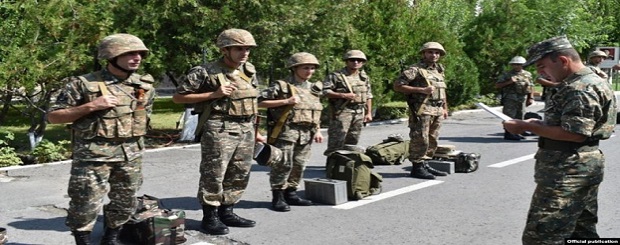
Russian and Armenian staffs in close contact during Armenian-Azeri clashes
Tuesday July 21, 2020 – armenews:
For the second day in a row, the fierce fighting that has been inflaming the very volatile Armenian-Azeri border since July 12 seemed to have lost intensity on Monday July 20, but the Armenian authorities made it clear that the Armenian and Russian staffs remained in contact. , as they had been during the fighting.
These fights, the most violent since the “4 days war” of April 2016 in Karabakh, left at least 12 dead in the ranks of the Azerbaijani army and 4 in those of the Armenian army, according to an official report published. July 16, when hostilities ceased.
Since then, no serious breaches of the ceasefire in force since 1994 have been reported along the heavily militarized border on both sides, but each side persisted in blaming the other for the fighting, while accusing each other of sporadic shooting at different sections of the border separating the province of Tavush, in north-eastern Armenia, from that of Tovuz, in Azerbaijan.
Armenian Foreign Ministry spokeswoman Anna Naghdalian said the US, French and especially Russian co-chairs of the OSCE Minsk Group had been “actively involved” in efforts to restore the ceasefire regime. -the fire in the areas concerned.
“The Armenian Minister of Foreign Affairs [Zohrab Mnatsakanian] has been in constant contact with his Russian counterpart,” added A. Naghdalian, questioned by the Armenian service of RFE / RL, specifying: “There were also official contacts at the level of the military officials of the two countries ”, without providing more details on the nature of these Russian-Armenian military contacts.
The Armenian and Azerbaijani staffs had established a direct communication link after a first informal meeting between Armenian Prime Minister Nikol Pashinian and Azeri President Ilham Aliyev which in 2018 resulted in a commitment to strengthen the ceasefire regime. fire along the internationally recognized border between the two countries and the “line of contact” around Karabakh.
The violations of the ceasefire had diminished as a result, prompting Nikol Pachinian to affirm, prematurely, only a few months after his accession to power, that he had managed to find a language with the authorities in Baku and that he had known how to establish an unprecedented climate of peace in the region. The tensions that have persisted since then and the escalation in recent days have got the better of his optimism, and the Armenian leader does not hesitate to raise his voice against Baku, accusing him of having dealt a severe blow to the peace process. of Karabakh.
President Aliyev, for his part, threatened once again on Thursday to withdraw from the Minsk Group-sponsored peace talks with Armenia, saying they had been “unnecessary” to date. He added that the American, Russian and French mediators should have done more to make the discussions more “substantial”, in addition to their efforts to prevent violence.
In an interview with Sky News Arabia TV channel, Z. Mnatsakanian, for his part, stressed that the resurgence of violence over the past week showed that “there can be no military solution to the conflict” and that the continuation of the negotiations is the only viable option.
In addition, Russia is said to have assured Azerbaijan that the military maneuvers aimed at testing the combativeness of Russian troops ordered by Russian President Vladimir Putin were in no way linked to the tensions on the Armenian-Azeri border.
Guarantees aimed at dispelling suspicions, maintained in particular by Turkey, that Russia is seeking to get involved with its Armenian ally in the South Caucasus. Russian Defense Minister Sergei Shoygu announced the launch of the exercises on Friday, saying they were intended to test the readiness of the Russian armed forces for the Caucasus-2020 military exercises scheduled for September.
He said they involved some 150,000 troops and hundreds of planes and warships deployed in the military regions of southern and western Russia, neighboring Ukraine, Georgia and Azerbaijan.
The official Russian news agency RIA Novosti indicated that Azerbaijani Defense Minister Zakir Hasanov had telephoned S. Shoygu on Saturday, an interview during which, in addition to these military exercises, questions of mutual interest.
The Russian Defense Minister reportedly assured that the military exercises were planned for a long time and had no connection with the current situation in the region.
The exercises began just as V. Putin was chairing a meeting of the Russian Security Council on the Armenian-Azeri fighting that broke out on July 12. For their part, the Armenian authorities echoed Russia, specifying that Armenian forces were to participate in the Caucasus-2020 exercises, as had been planned well before the fighting last week.

by Garo Ulubeyan on Tuesday July 21, 2020
© armenews.com 2020
English translation – LOUSAVOR AVEDIS:


