
The Chester Concession: Genocide, Occupation, and the Hidden History of American Turkish Resource Deals – Ara Khachig Manoogian

Ara Khachig Manoogian, Global Peace International
Executive Summary
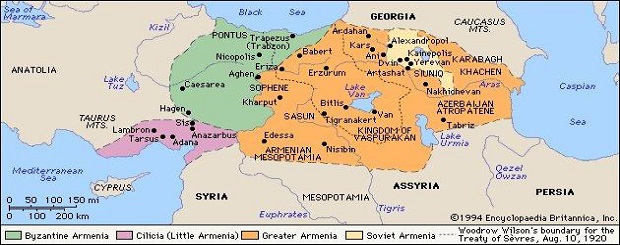
The Chester Concession, ratified in 1923, was a transformative episode in the entwined histories of genocide, resource theft, and modern state-formation spanning the Eastern Mediterranean, the Caucasus, and the Middle East. The scheme, engineered by American and British syndicates and enabled by a compliant Turkish parliament, was publicly justified as a development project but was in reality a program to transfer immense copper, oil, and mineral wealth from genocide-emptied Armenian lands to Western interests. Chester and period press openly boasted that the project’s profits would pay off the entire U.S. national and war debt, then exceeding $20 billion, and the full cost quoted for infrastructure and minerals was over $300 million—rivaling the annual budgets of leading world powers.¹ ²
Contemporary geological estimates put Western Armenian oil at as much as one-sixth of the world’s accessible supply (four to eight billion barrels), at a critical time when the U.S. was forecast to run out of oil within ten years.³ ⁴ Strategic moves to exclude Armenia from those fields at Lausanne were driven by U.S. mineral and oil calculations.
Key Participants in the Chester Concession and Broader Power Structures
The Chester Concession was orchestrated by networks that went on to shape the post-Ottoman regional order, including the formation of Azerbaijan, the Turkish Republic, and—by extension—Israel. Their overlapping banking, legal, and intelligence links set precedents for subsequent resource and population policies:
– Rear Admiral Colby M. Chester: Head of the syndicate, U.S. Navy veteran, and agent of American mineral and political interests in the region.¹⁴
– Arthur T. Chester: Colby’s son and operational head, chief negotiator, builder of legal and logistical frameworks in Turkey.¹⁴
– Prime Minister Hüseyin Rauf Orbay: U.S.-trained (Annapolis), the key political enabler who shepherded the concession through Turkey’s parliament and gave legal cover to Western asset transfers.⁶
– James W. Colt: Wall Street intermediary, mineral surveyor, link between Chester and post-Russian Baku, enabling early oil/rail integration; part of the financial web that later helped found Israel.¹⁵
– Jacob Schiff (Kuhn, Loeb & Co.): American financier of Turkish, Armenian, and Azerbaijani investments; also a founding supporter of Zionist aspirations that culminated in Israel’s formation.¹⁵
– Henry Woodhouse: Press agent and document dealer, promoter of international mining and railway speculation, and a forger whose strategies informed later PR in the Middle East.¹⁴
– George W. Goethals: Chief engineer (Panama Canal), builder of the logistics that tied together Turkish, Azerbaijani, and later Israeli development projects.¹⁴
– Kenneth E. Clayton-Kennedy: Legal and operational fixer for the syndicate; managed contractual ambiguities to benefit U.S. interests.¹⁴
– Admiral Mark Lambert Bristol: U.S. High Commissioner to Turkey, provided government sanction and diplomatic impetus for American syndicate deals.¹⁴
– G. Ward Price: Daily Mail journalist and chief PR voice for the Turkish, Azerbaijani, and postwar Israeli narratives in the West.⁹
– Kermit Roosevelt: Publicist and multifaceted syndicate operator—second son of President Theodore Roosevelt and part of the broader Anglo-American elite, whose contacts permeated Middle Eastern policy, linking Chester operations to the eventual roots of Israeli state-building.¹⁴
– The Turkish National Assembly, President Mustafa Kemal Atatürk: Formal ratifiers of the deal; pivotal in transforming the Ottoman legacy into a national and international legal system that served Western interests and blocked Armenian restitution, while Atatürk’s regime coordinated with Baku’s leadership and formed pivotal postwar alliances.²⁴
– Henry Morgenthau Sr., U.S. Ambassador to the Ottoman Empire during World War I, played a deeply complex—and at times controversial—role; while publicly decrying the Armenian Genocide and helping raise humanitarian funds, he also pursued a secret U.S. mission to secure Palestine as a future Jewish homeland, coordinated with Zionist financiers, and engaged in direct negotiations with Talaat Pasha that included plans to depopulate Armenia in exchange for admitting European Jews, all while remaining deeply active in transnational fraternal networks such as B’nai B’rith and the Alliance Israélite Universelle—demonstrating his overlap with the very Anglo-American power structures shaping regional population transfers and asset deals during the Chester Concession era.⁴
These figures fueled the model of asset and population transfer that underpinned the making of modern Turkey, Azerbaijan, and pre-state Israel, and whose strategies persist in global state-building and resource expropriation.
U.S. Entrenchment and Turkish Parliamentary Engineering
Orbay and the American-educated Turkish leadership guided legislation (notably Article 4) that, in concert with Chester’s syndicate, enabled foreign investors to control enormous tracts of land and minerals by laundering ownership through Turkish corporate entities.⁶ Parliamentary proceedings and contemporary correspondence demonstrate a calculated refusal to address Armenian dispossession, instead emphasizing “modernization” and Western capital’s partnership.⁶ ⁷
“Nonsensical War” and Chester’s Sulfur Concession
Chester publicly asserted that World War I, rather than being sparked by alliances or state rivalries, was triggered by mineral concessions in the Ottoman Empire, and specifically his refusal to grant an American capitalist a stake in the “Tripolitan sulfur concessions” he controlled. “This,” Chester stated, “was the prime cause of the Italian-Tripolitan war. This led immediately into the first Balkan war, that led to the second, and that in turn caused the world war.”¹¹ His failed attempt to buy 100 interned German warships for Turkey’s navy further reveals the depth of syndicate involvement in the region’s military and political affairs.¹¹
Copper, Oil, and Corporate Cartography
Business correspondence and congressional records confirm the Chester syndicate’s repeated claim that copper profits alone would cover all project debts. Strategic model maps show that railroad routes were designed to intersect copper and oil fields (Arghana-Maden and others), and boundary changes after Lausanne—imposed on Armenia—were part of this mineral calculus.³ ¹⁴ ⁵
Article 4: Legal Fiction and Asset Laundering
Article 4 of the Chester Concession, written into Turkish law, required foreign control to be masked as Turkish corporate activity. Shares and profits flowed solely to syndicate interests, with no compensation to Armenians or other dispossessed local peoples.⁶ ⁸ ¹² No restitution mechanism was ever created.
Propaganda and Genocide Denial
Chester, Price, Woodhouse, and Orbay orchestrated a campaign through National Geographic, Current History, and the Daily Mail to recast the Turkish regime as reform-minded, minimizing the Armenian genocide while defending the syndicate’s business as a humanitarian and civilizing mission.¹³ ⁹ These narratives paralleled later defenses used to legitimize state-building in Azerbaijan and Israel.
Critique of Historical Documents and Their Shortcomings
The white paper systematically critiques all major documents:
– Wikipedia (“Chester Concession”): Only provides a superficial summary, omitting legal, financial, and Armenian aspects, as well as regional strategy.⁷
– JSTOR: “The Chester Concession as an Aid to New Turkey”: Focuses on diplomatic context, lacking operational/legal analysis and missing the grand strategy, propaganda, and asset structure.⁸
– Cambridge Review, “A Railroad for Turkey: The Chester Project, 1908–1913”: Properly details technical plans but omits ratification context, asset movement, and legal-political developments.¹²
– U.S. Senate Hearings, 66th Congress, 1919: Valuable for testimony but ignores post-ratification asset laundering and Armenian dispossession.¹⁰
– Gizem Magemizoglu, “A Case Study of Turkish-American Relations: The Chester Concessions” (UNC/Academia.edu): Diplomatic summary, but weak on law, mineral extraction, and post-genocide consequences.¹⁸
– The New York Times, 1923–1924: Covers public negotiations but not logistical or asset details, nor the denial of Armenian claims.¹⁹
– Berlin Economics and Massis Post: Document scale of resources but omit the Chester network’s seizure, the regional legal subterfuge, or the interface with future Israeli and Azerbaijani policymaking.²¹ ²²
– Price, G. Ward (Daily Mail): Shapes opinion in favor of the syndicate, omits Armenian claims, presents pro-Turkish and pro-British narratives, and assists the normalization of forced territorial loss.⁹
For a thorough documentation of the Chester Concession, its background, detailed participant biographies, and extensive review of the historical record, consult Betrayal: The Promise Never Kept—Genocide and the West’s Secret War for Oil by Ara Khachig Manoogian at: https://a.co/d/diLTu3K
About the Author
Ara Khachig Manoogian is a researcher and writer with Global Peace International. His work focuses on historical justice, Armenian studies, and the political economy of post-genocide asset restitution, drawing on primary archival research and international legal advocacy.
Footnotes:
¹ Charles G. Ross, St. Louis Post-Dispatch, April 29, 1923.
² “Chester Concession,” Wikipedia.
³ Manoogian, Turkey Unmasked, ch. 2–3.
⁴ U.S. Geological Survey, 1912; Chester interviews, as cited in *Betrayal*.
⁵ UNH Thesis, “U.S. Foreign Policy Toward Turkey…”
⁶ Chester Concession Agreement, *Turkey Unmasked*, Betrayal, and Turkish parliamentary sources.
⁷ Wikipedia critique, accessed 2025-10-29.
⁸ JSTOR, “The Chester Concession as an Aid to New Turkey.”
⁹ Price, Daily Mail, and pro-Turkish press, 1922–24.
¹⁰ U.S. Senate Hearings, 66th Congress, 1919.
¹¹ Betrayal: The Promise Never Kept, pp. 101–102.
¹² Cambridge Review, “A Railroad for Turkey…”
¹³ National Geographic, Chester, Current History, syndicate PR.
¹⁴ Betrayal, ch. 28–29, litigation, biographies, legal structures.
¹⁵ Colt-Schiff correspondence; Wall Street–Baku links, Betrayal.
¹⁸ Gizem Magemizoglu, “Case Study…”, UNC 2021.
¹⁹ The New York Times, 1923–24.
²¹ Berlin Economics, 2024.
²² Massis Post, “Armenia’s Mineral Deposits,” 2013.
²³ Manoogian, Betrayal: The Promise Never Kept.
²⁴ Turkey Unmasked, ch. on Baku consolidation, Turkish-Azerbaijani republic policy, British intelligence, and the formation of Israel.
Sources:
[1] TURKEY (CHESTER CONCESSION). (Hansard, 25 April 1923) https://api.parliament.uk/…/25/turkey-chester-concession
[2] (DOC) The Chester Concessions – Academia.edu https://www.academia.edu/45470956
The_Chester_Concessions
[3] THE CHESTER CONCESSION AS AN AID TO NEW TURKEY – jstor https://www.jstor.org/stable/45469118
[4] New Ankara in the Scope of Chester Concession https://www.tuba.gov.tr/…/new-ankara-in-the-scope-of…
[5] Chester concession – Wikipedia https://en.wikipedia.org/wiki/Chester_concession
[6] Profiting from Genocide: The Chester Concession and – Facebook https://www.facebook.com/groups/401527916682645/posts/3098775850291158/


