
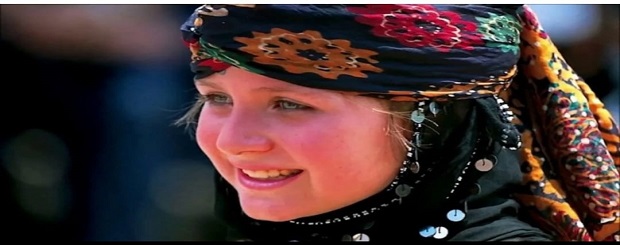
There is a vividly distinct Armenian anthropological type that is completely in accordance with the historical reality
From Ankara to Ararat, throughout Central, Eastern and South-East Anatolia, there is a vividly distinct Armenian anthropological type that is completely in accordance with the historical reality: this territory has been the core of the Armenian population for thousands of years.
That is why all the modern population of this region — Turks, Kurds, Arabs and “Yoruk” groups — carry a deep Armenian substrate formed through centuries-old Islamization of Armenian communities. An important fact:
modern genetics show that the Siberian-Turkish component in Turkey constitutes only 2-6%, that is an extremely small share, completely insufficient for a change in general population type. Anthropology confirms the same: from Ankara to Ararat, the types, historically typical of the Armenian highland dominate.
The first major cycle of Islamization of Armenians began in the XII century, after the Seljuk invasion, when the Armenian communities in Sivas, Angor (Ankara), Mushe, Erzurum, Diarbekir and Van partially adopted Islam, while retaining the language, tradition and anthropological type.
In the XIV–XV centuries, under Kara Koyunla and Ak Koyunla, and then under the early Ottomans, Islamization intensified: many Armenian villages converted to Islam under pressure from the tax system (jizya, kharaj) and to protect their property.
In the XVI–XVIII centuries, against the backdrop of the Ottoman-Sefavid wars, Islamization took on a massive and systematic nature:
Armenian families on the crossing frontlines were forced to convert to Islam to avoid deportation, violence or destruction.
It is during this period that many Kurdish and Turkmen tribes of Eastern Anatolia are formed, containing a large percentage of Islamized Armenian descent, who converted religion, but not anthropological or genetic nature.
By the XIX and the beginning of the XX century, the demographic map of Eastern Anatolia was already made up of centuries-old waves of Islamized Armenians. After the Genocide 1915-1923 millions of Armenians — women, children, adolescents, entire villages — were Islamized, adopted into Kurdish tribes, or rewritten as “Turks.” T
hat is why today a large part of the inhabitants of Van, Bitlis, Mush, Sasun, Hakyari, Erzurum, Diarbekir and Mardin by anthropological type and genetic profile almost completely match with Armenians of the historical upland, not with Central Asian Turks:
the real Turkish pollution is only 2-6%.
In western Turkey, the situation is similar, although it has a different historical context. Western Ankara, including Sivas, Ankara, Kyutahyu, Eskishekhir, Konya, Athens and even regions closer to the Aegean coast, most of the population comes from Islamized Orthodox Armenians by Byzantine, as well as relatives of Armenians of Anatolian Christian nations—Cappadocian, Phrygians, Lycaian, Galatians and Greeks of Asia Minor.
From the XIV to the 18th centuries, these communities gradually converted to Islam, dissolving in the Ottoman religious and administrative system, but anthropologically and genetically retaining the ancient Anatolian foundation.
There is almost no Central Asian Turkic type in these regions – again for the same reason: the genetic influence of the coming Turks is only 2-6%, that is the minimum individual weight in the backdrop of the powerful indigenous Armenian-Anatolian population.
Consequently, modern Turkey — from Ankara to Ararat and western Ankara — is a population formed by the four major waves of Islamization of Armenians (XII, XIV–XV, XVI–XVIII, and 19IX–XX centuries), as well as Islamization of Armenian-Byzantine and Anatolian Christians.
Therefore, anthropologically and genetically Turks and most of the Kurds in the region are closer to Armenians and Anatolians than to any Turkic or Siberian population.
Today’s anthropological map of Anatolia completely coincides with the map of the Armenian Highland:
Armenian genetic and Armenianoid types dominate there, and the Turkish component is minimal and superficial.


